
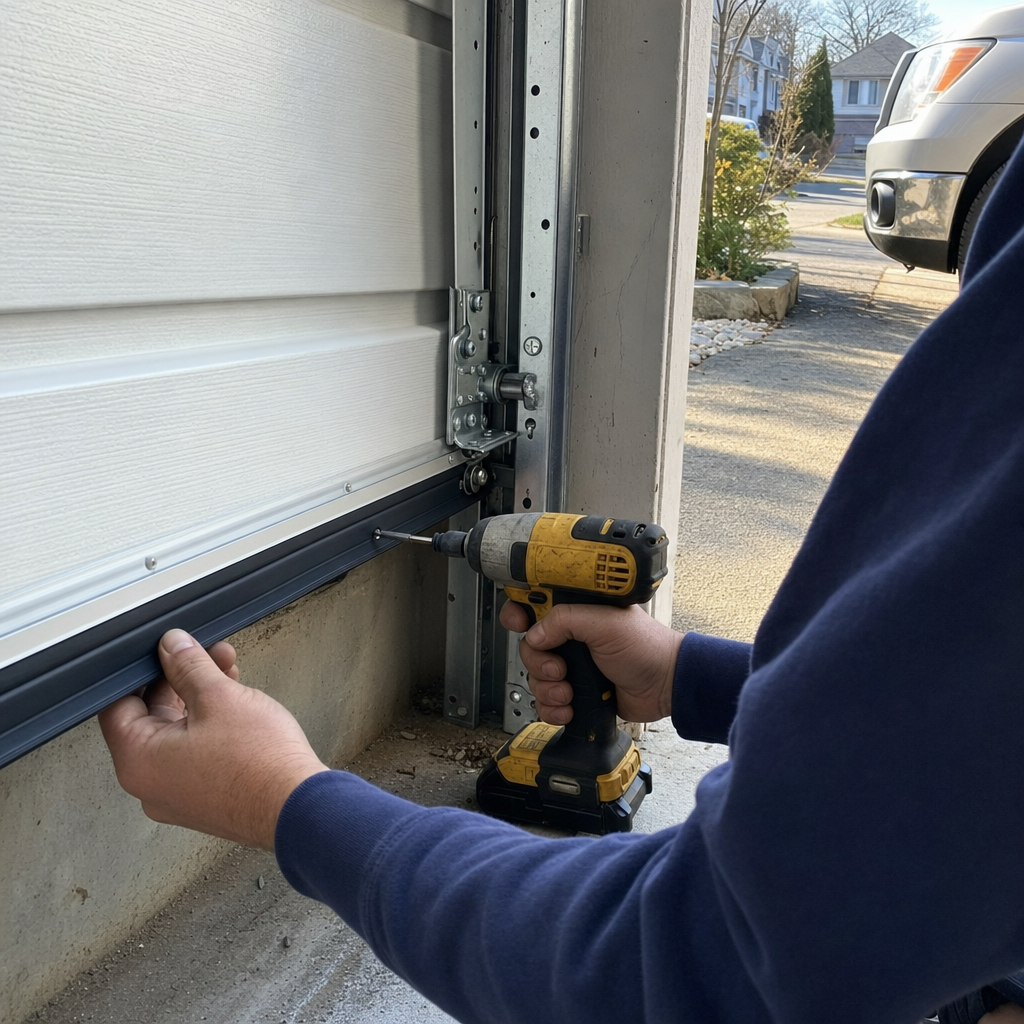
Why Does My Garage Door Reverse in Frederick, MD?
Your garage door reverses because its safety systems are detecting an obstruction that either exists or is being falsely registered. The two most common causes in Frederick are misaligned or dirty photoelectric safety eyes (reversal before ground contact) and a close-force limit set too low for cold-weather resistance (reversal at or near the floor). Both trigger the same frustrating symptom, but they require completely different fixes.
If you’re standing in your driveway in Ballenger Creek or Urbana watching your door climb back up just as it’s about to seal, you’re not alone. We field this call constantly once temperatures drop below freezing in Frederick’s valley. The good news: some causes are homeowner-fixable in five minutes. The rest are straightforward for a technician who knows which of the two sensor systems is actually complaining. Call (888) 583-9199 for Emergency Garage Door Repair in Frederick, MD if you’d rather skip the diagnosis and get straight to the fix.
The Two Reversals: Before Contact vs. At Contact
Most Frederick homeowners — and frankly, too many generalist repair outfits — treat “my door reverses” as one problem. It’s not. The distinction determines whether you’re wiping a lens or recalibrating force limits.
Reversal before touching the ground: Your door travels most of the way down, then reverses a foot or more above the concrete. This is the photoelectric safety eye system — two small boxes near the floor on either side of the track, shooting an invisible beam across the opening. Break that beam, or make the system think it’s broken, and the opener reverses automatically. It’s federal safety law, and it’s non-negotiable.
Reversal at or immediately after floor contact: The door reaches the ground, touches, then bounces back up. This is the close-force limit system inside the opener motor unit. It measures how hard the motor is working to pull the door down. Hit a programmed resistance threshold, and the opener assumes it’s crushing something — a bike, a pet, a kid — and reverses hard.
In Frederick’s older subdivisions, we see both failures spike in late January through early March. The cause isn’t always the same, but the pattern is: a 20°F morning after a thaw cycle, and suddenly half a cul-de-sac in Urbana is having door trouble. That’s not coincidence. It’s the valley geography between the Catoctin and South Mountain ridges trapping cold air and producing sharper freeze-thaw cycling than the DC or Baltimore suburbs see.
Photoelectric Eye Problems: The “Reverses Early” Diagnosis
When your door reverses before ground contact, start here. These checks take under five minutes and solve roughly 40% of the calls we get for this symptom.
What to Check on the Safety Eyes
- Alignment: The two eyes must face each other squarely. Bump one with a rake handle, a trash can, or a kid’s hockey stick, and the beam misses. Most units have an LED indicator — steady green or amber means aligned; blinking or dark means they’re talking past each other.
- Lens cleanliness: Road salt, garage dust, and spider webs film over the lens. Wipe both with a soft cloth. We’ve seen doors reverse because a single cobweb interrupted the beam at just the right angle.
- Obstruction in the beam path: Boxes, bikes, leaf bags, the corner of a parked car. The beam sits 4–6 inches off the floor — low enough that clutter accumulates in it.
- Wiring integrity: The low-voltage wire running from eye to opener can get pinched by a stray staple or gnawed by mice, especially in detached garages common in Clover Hill and the older Ballenger Creek sections.
Here’s a detail most competitors won’t mention: in Frederick’s 1990s–2010s colonial and craftsman-style homes with attached two-car garages, the builder-grade openers installed during the subdivision boom often have cheap, flexible eye brackets that sag over time. The eyes look aligned at rest but drift apart under vibration. We replace these with rigid steel brackets on every Garage Door Repair call where eyes are the culprit — it’s a five-dollar part that prevents callbacks.
If you’ve checked alignment, cleaned the lenses, and cleared the beam path, and the door still reverses early, the eyes themselves may be failing. Sunlight flooding a garage at certain angles can also blind older sensors. That’s when we recommend replacement — usually a 15-minute job if the wiring’s intact.
Close-Force Limit Problems: The “Hits Floor, Then Reverses” Diagnosis
This is where Frederick’s climate becomes the star of the show. When your door touches the ground and immediately heads back up — or stalls and reverses on the final inch — the opener’s force sensor is the issue. And cold weather is often the trigger, not a mechanical failure.
How Cold Mornings Fool Your Opener
At 20°F, several things happen simultaneously in a typical Frederick garage:
- Torsion spring tension drops: Cold steel contracts slightly and becomes less elastic. The springs that do the heavy lifting of your door lose effective tension, forcing the opener motor to work harder.
- Rollers stiffen: Nylon rollers get sluggish; steel rollers with dried grease feel like they’re dragging through sand. The opener senses this as resistance.
- Bottom seal drag: Rubber or vinyl seals harden and flatten against frost-heaved concrete. In Frederick’s valley, where freeze-thaw cycling is more pronounced than in flatter communities to the east, concrete aprons heave slightly and create ridges that the seal catches on.
- Track misalignment from frost heave: The same freeze-thaw stress that cracks sidewalks can shift vertical track mounting slightly, adding friction the opener interprets as obstruction.
The opener’s logic is simple: “I’m working too hard to close. Something must be under the door. Reverse.” It’s a safety feature, but in Frederick’s late winter, it’s often a false alarm caused by the combined cold-weather drag of legitimate components.
When Self-Adjustment Is Safe — And When It Isn’t
Most openers have two adjustment screws or dials on the motor housing: one for up-force, one for down-force (sometimes labeled “close force”). The down-force limit controls how much resistance triggers reversal.
For LiftMaster and Chamberlain units (the dominant brands in Frederick’s suburban ring), the adjustment is typically a small plastic screw on the side or back of the motor unit, marked with arrows. Turn it a quarter-turn clockwise to increase close force. Test with a 2×4 laid flat in the door’s path — the door should reverse on contact. If it doesn’t reverse, you’ve overridden safety logic and need to back off immediately.
For Genie chain-drive units common in early-2000s Ballenger Creek builds, the limit is often a digital setting accessed through the wall control or a learn button sequence. Consult your manual — we keep copies of the most common Frederick-area models on our tablets.
Here’s the critical boundary: if a small adjustment (one or two quarter-turns, or one digital increment) solves the problem on a mild day, you’re probably fine. But if you find yourself cranking the force higher every cold morning, you’re masking a mechanical problem — worn springs, binding rollers, or a damaged bottom seal — that will eventually damage the opener or create a genuine safety hazard. That’s when you call a technician.
We don’t recommend DIY force-limit adjustment on torsion-spring doors if you don’t know the spring’s condition. A door with a fatigued spring needs more opener force to close, but the real fix is spring replacement — typically $180–$340 in Frederick. Masking it with force adjustments burns out the opener motor over time, turning a $180–$340 spring job into a $250–$550 opener replacement.
The Frederick-Specific Culprit: Frozen Bottom Seals
This one catches even experienced homeowners. Your door closes fully, seals against the floor, then reverses 10–30 seconds later — or reverses on the next open command because it’s frozen down.
In Frederick’s valley winters, damaged or aging bottom seals collect meltwater during the day, then freeze to the concrete threshold overnight. The opener’s initial close cycle completes normally — the force limit isn’t triggered because the seal compresses gradually. But the seal is now glued to the floor by ice. When you hit the remote next morning, the opener tries to lift, senses the resistance of the frozen seal, and reverses.
Homeowners in Urbana’s newer builds with poured-concrete aprons see this less often. But in Ballenger Creek and Clover Hill, where some 1990s construction used thinner concrete with less base preparation, frost heave creates exactly the ridges and gaps where water pools and freezes.
The fix isn’t opener adjustment — it’s seal replacement ($110–$220, depending on width and whether the retainer is damaged) and sometimes threshold leveling. We carry common seal profiles for the Clopay, Amarr, and Wayne Dalton doors that dominated Frederick’s subdivision era.
When Reversal Signals Something Serious
Most reversal issues are nuisance-level. A few indicate real danger.
Broken spring with opener override: A torsion spring break removes 80–90% of the door’s counterbalance. The opener now lifts the full weight — and often can’t, or strains so hard the force limits trigger. If your door reverses and one side hangs lower than the other, or you hear a loud bang from the garage, do not keep cycling the opener. The door can crash or the opener can tear off the header. This is when you need Best Garage Door Repair in Frederick, MD — a $180–$340 spring repair, but continuing to operate risks a $700–$2,200 door replacement or injury.
Frayed cable jammed in roller: Cables wind around drums beside the end bearings. When they fray and snag, they create intermittent resistance that the opener reads as obstruction. Cables under tension are dangerous — $130–$250 for professional cable replacement, not a DIY project.
Track separation or roller derailment: If a roller pops out of the track, you need Garage Door Off Track Repair in Frederick, MD — the door binds and reverses. Operating it repeatedly bends the track and damages panels. $120–$240 for track realignment if caught early; panel replacement runs $250–$500 per section if the door gets forced.
Paul Torres has been working garage doors in Frederick for over eleven years, and most of that time you’ll find him on the job himself rather than dispatching someone else. He grew up near Baker Park and picked up his mechanical instincts early, eventually training through the trades program at Frederick Community College before going deep into spring systems, openers, and custom door installations on his own terms. He’s known around Frederick for honest assessments — if a spring can be adjusted instead of replaced, he’ll tell you that — and for getting residential and light commercial calls buttoned up the same day without cutting corners. Outside the shop, Paul coaches youth baseball on weekends, which is probably why he’s patient explaining things to homeowners who’ve never touched a garage door in their lives.
What This Costs to Fix in Frederick
Reversal issues span a wide range depending on root cause. Here’s what we see in the field:
| Repair | Typical Range in Frederick |
|---|---|
| Safety eye alignment / bracket replacement | $120–$180 (service call + minor parts) |
| Safety eye replacement (both units, wiring intact) | $150–$250 |
| Close-force recalibration + roller lube | $120–$180 |
| Spring repair (torsion, standard door) | $180–$340 |
| Cable repair | $130–$250 |
| Roller replacement (full set, 10–12 rollers) | $110–$220 |
| Bottom seal replacement | $110–$220 |
| Opener repair (gear, limit switch, logic board) | $120–$320 |
| Opener installation (if unit is fried) | $250–$550 |
We don’t charge for the diagnosis if you proceed with the repair. If it’s a two-minute eye realignment and you’re comfortable doing it yourself, we’ll tell you that on the phone — no charge for the honesty. “If it’s not right, we’re not done.”
Key Takeaways
- Reversal before ground contact = photoelectric eye issue (alignment, dirt, obstruction, or sun interference).
- Reversal at floor contact = close-force limit or mechanical resistance issue, often worse in Frederick’s cold mornings.
- Cold-weather drag from stiff springs, rollers, and frozen bottom seals is a Frederick-specific pattern due to valley geography and sharper freeze-thaw cycling.
- Small force-limit adjustments are homeowner-safe; repeated adjustments mask mechanical problems that need professional repair.
- Frozen bottom seals mimicking sensor problems are common in older Frederick subdivisions with frost-susceptible concrete.
- Reversal accompanied by uneven door hang, loud bang, or visible cable fray = stop operating and call a technician.
FAQs
The photoelectric safety eyes are misaligned, dirty, or receiving sunlight glare that mimics a broken beam. Check that both eye LEDs are steady (not blinking), wipe the lenses, and verify nothing sits in the beam path 4–6 inches off the floor. If the problem persists in direct morning or evening sun, you may need shaded or upgraded eyes — call (888) 583-9199 for an exact diagnosis; estimates are free.
Most reversal fixes run $120–$340 in Frederick, depending on whether it’s a simple eye realignment, force recalibration, or spring/roller repair. Opener replacement if the motor is damaged runs $250–$550. We diagnose before quoting — no surprises. Call (888) 583-9199 for an exact quote; estimates are free.
You can safely check and clean photoelectric eyes, clear beam-path obstructions, and make minor force-limit adjustments on chain-drive or belt-drive openers. Do not attempt spring, cable, or track repairs — these components store lethal tension. If your fix doesn’t hold through a cold morning, the underlying problem is mechanical and needs a technician. Call (888) 583-9199 before the issue escalates to opener damage.
Frederick’s valley location produces colder overnight lows and sharper freeze-thaw cycles than DC or Baltimore suburbs. At 20°F, torsion springs lose tension, rollers stiffen, and bottom seals drag or freeze to frost-heaved concrete — combined resistance that triggers the opener’s force-limit reversal. The door isn’t broken; it’s fighting itself. A force recalibration plus roller lubrication often solves it; persistent cold-morning reversal usually indicates worn springs or a damaged seal. Call (888) 583-9199 for a same-day check — estimates are free.
If you’d rather have it looked at, Legacy Garage Door Service Frederick offers a no-pressure assessment in Frederick — call (888) 583-9199.
Written by Paul Torres, Owner & Lead Technician at Legacy Garage Door Service Frederick, serving Frederick, MD.